Your dog didn't get worse. He became a teenager.
Chewing, pulling, ignoring you: around six months most dogs "forget" everything. It's a documented stage, and it ends. Here's the 30-day plan, about 10 minutes a day.
Get the 30-day plan — $4.99Instant PDF · 30-day money-back guarantee
Founder price for the first 200 readers, then $7.99.

If this is your week
- The couch, shoes, baseboards: if it's at nose height, it's gone.
- Recall that worked at four months now gets a look, and then he runs the other way.
- Walks are twenty minutes of being dragged, and between 6 and 9 p.m. he comes apart.
In a 2020 Newcastle University study, eight-month-old dogs ignored their own owner, but not a stranger. By twelve months it had passed. You didn't break him.
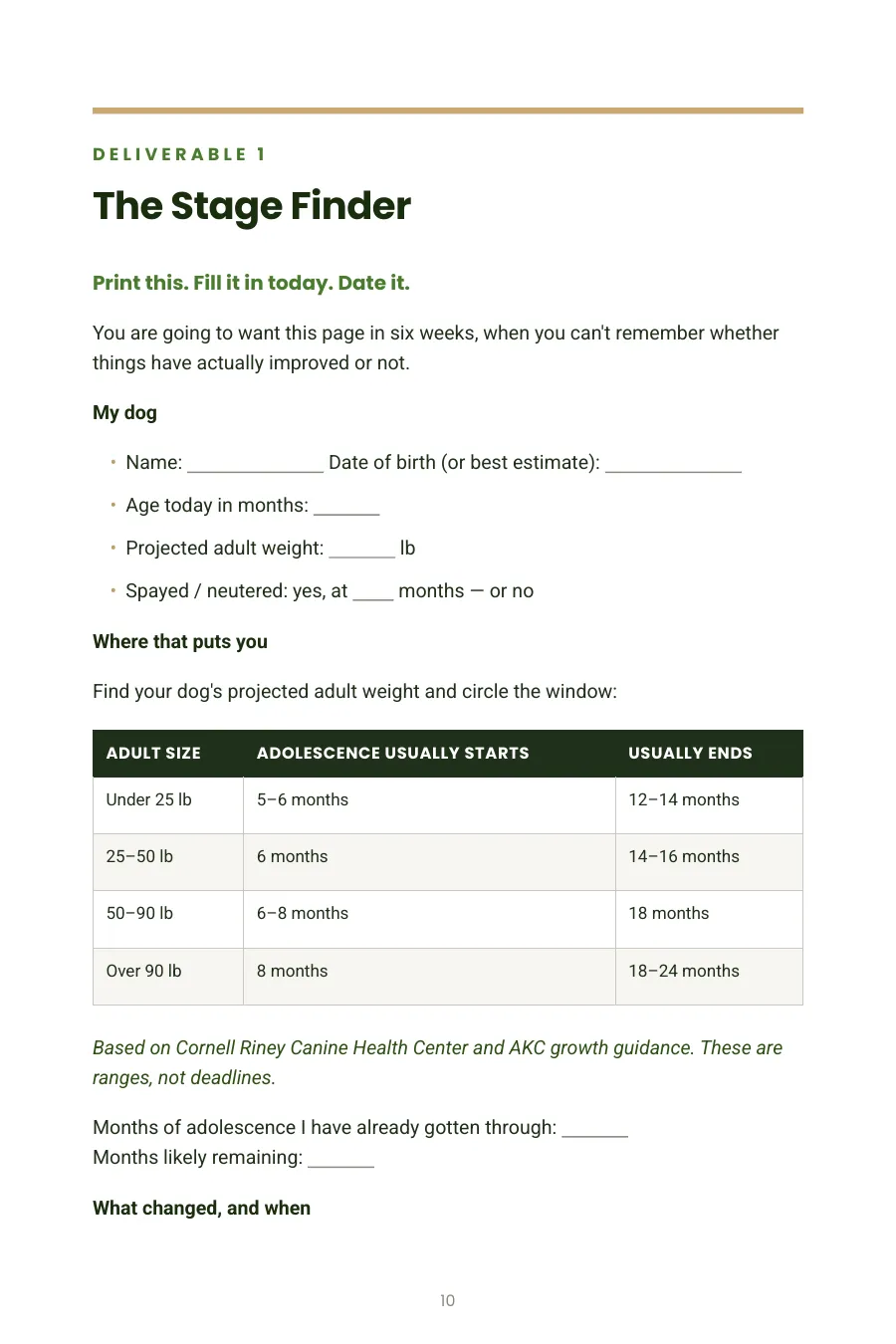
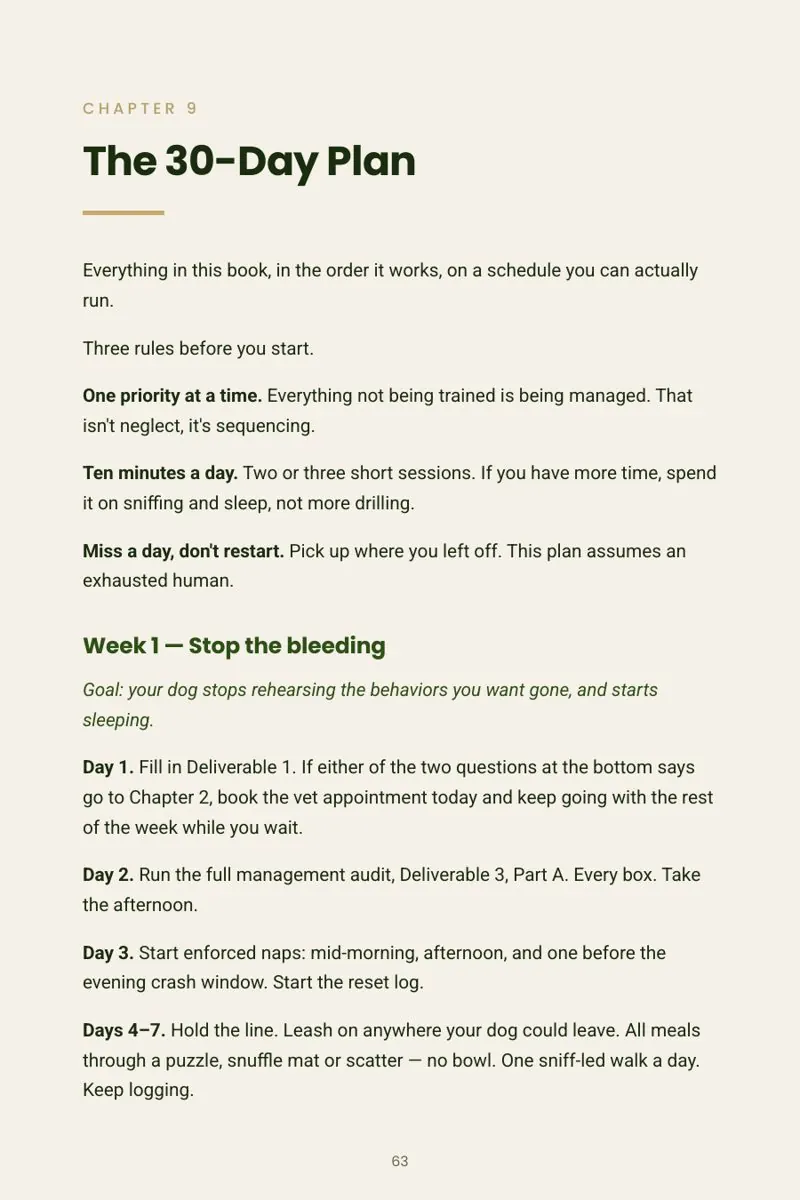
Two of the pages you'd print tonight
Tap a page to see it full size.

The Teenage Dog Handbook
A 73-page PDF, plus 9 printable worksheets
- The 30-day plan, about 10 minutes a day
- 9 worksheets you print at home
- Instant download, yours to keep
Instant PDF · 30-day money-back guarantee
Secure checkout through Lemon Squeezy
30 days. No questions, no form.
If it's not for you, email support@mytrustedpaw.com within 30 days and get every cent back. Keep the files either way.
"PASTE THE REAL QUOTE HERE"Name, dog's name and age
Quick questions
$4.99 for a PDF?
You're paying for the order: comfort first, then management, then sleep, then training. One session with a private trainer usually costs more, and the Handbook is yours to keep.
Is my dog the right age?
It's built for roughly 6 to 18 months, any breed. Small dogs tend to finish sooner, and giant breeds can run to 24 months. The Stage Finder shows you where yours is. If your dog is well past two, this book is a looser fit.
How do I get it?
Right after checkout, as a download and by email. It reads fine on a phone. Payment runs through Lemon Squeezy, and your card never touches this site.
The stage ends either way.
The question is what your dog learns while it lasts: thirty days of a plan, or thirty days of hoping he grows out of it.
Get the 30-day plan — $4.99Instant PDF · 30-day money-back guarantee
Read everything inside the Handbook
What changes in 30 days
- The day has a rhythm, and the evening crash is smaller or gone
- Your dog is sleeping, which changes more than you'd expect
- Your home stops feeding the behaviors you're fighting
- Your top-priority cue works at home and in at least one other place
- A real settle: your dog lies down and stays down while life happens around them
- Pain and medical causes checked first, so you're not training around a problem that isn't behavioral
- Recall rebuilt the safe way: indoors first, then in a fenced space. Outside a fence, the leash stays on until adolescence ends. That's deliberate: your dog never gets to practice ignoring you in open space, which is the hardest habit to undo.
What's probably still hard at day 30: recall around big distractions, leash walking somewhere busy, and anything fear-related, which moves in months, not weeks. The book says so up front.
The 9 chapters
- What Actually Happened to Your DogThe brain and hormone changes behind "he forgot everything."
- Rule Out Pain Before You Rule Out Anything ElseIn veterinary behavior cases, 28–82% of dogs showed signs of pain.
- The Reset WeekStop the rehearsals before you train anything.
- Sleep, Exercise, and the Arousal BudgetWhy "exercise him more" often backfires.
- Rebuilding the Four Cues That BrokeRecall, leash, jumping and barking, plus the settle.
- Fear, Reactivity, and the Second Fear PeriodDistance, not flooding.
- Health at This Age: Vaccines, Growth and WeightThe one-year booster, growth plates, retained baby teeth and body condition.
- Red Flags: When It Isn't BehaviorBloat, poisoning, swallowed objects and the signs that can't wait.
- The 30-Day PlanWeek by week, with ten minutes of training a day.
The 9 worksheets (tap to see each page)
The Stage Finder
Where your dog is in adolescence, and how much is likely left.
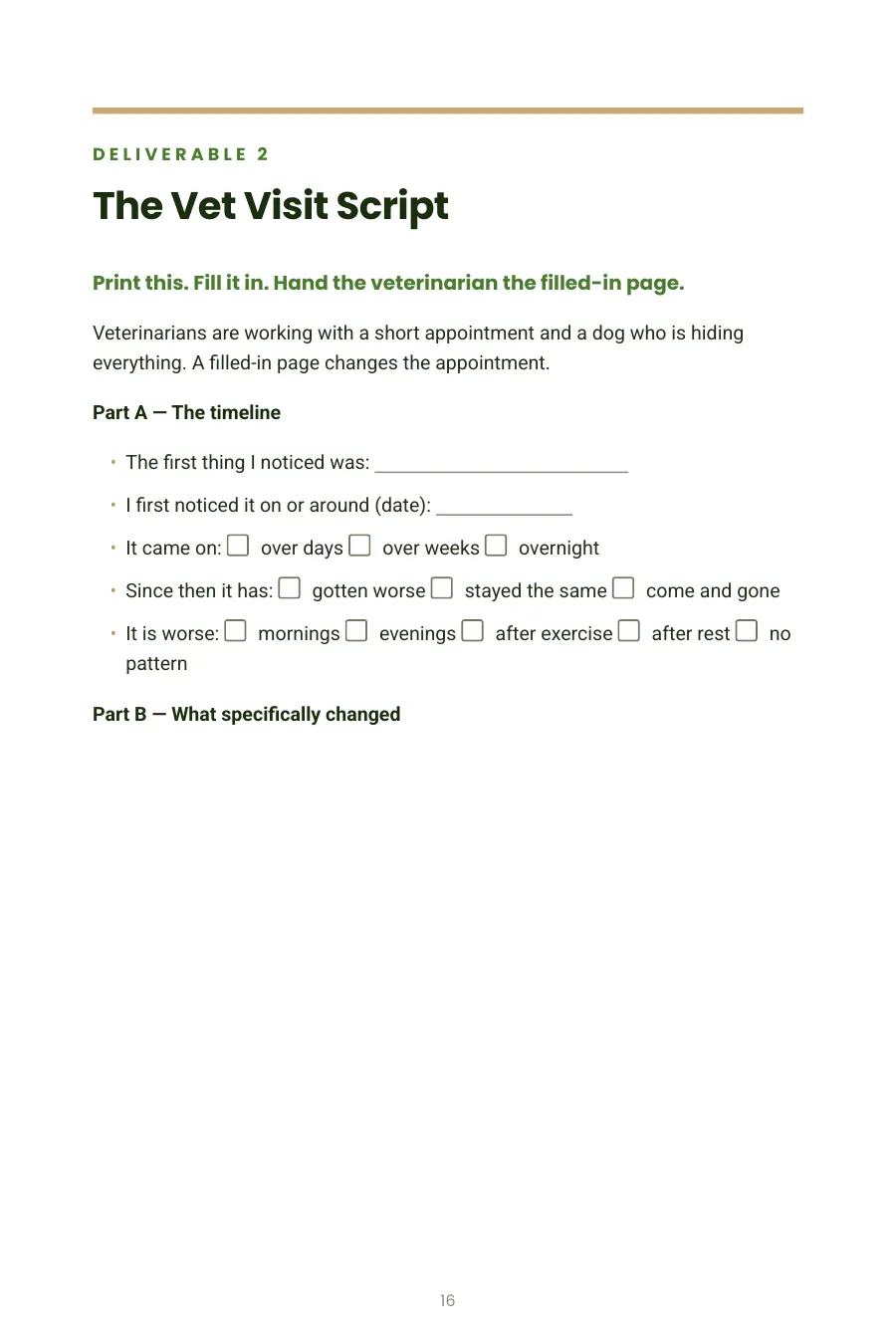
See this pageThe Vet Visit Script
The timeline and four questions that get you a real workup, not "he's just a teenager."
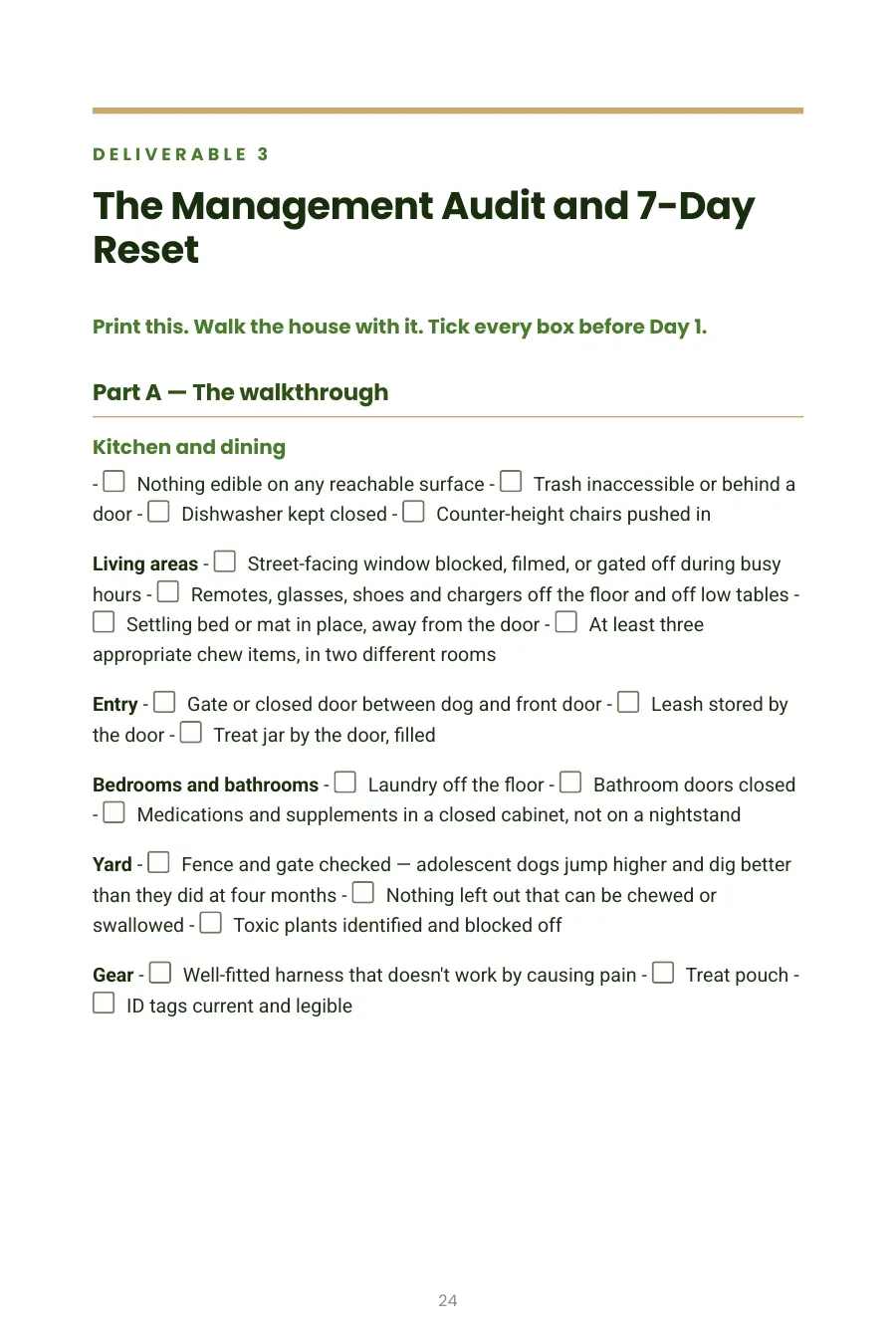
See this pageThe Management Audit & 7-Day Reset
A room-by-room walkthrough, plus a daily log.
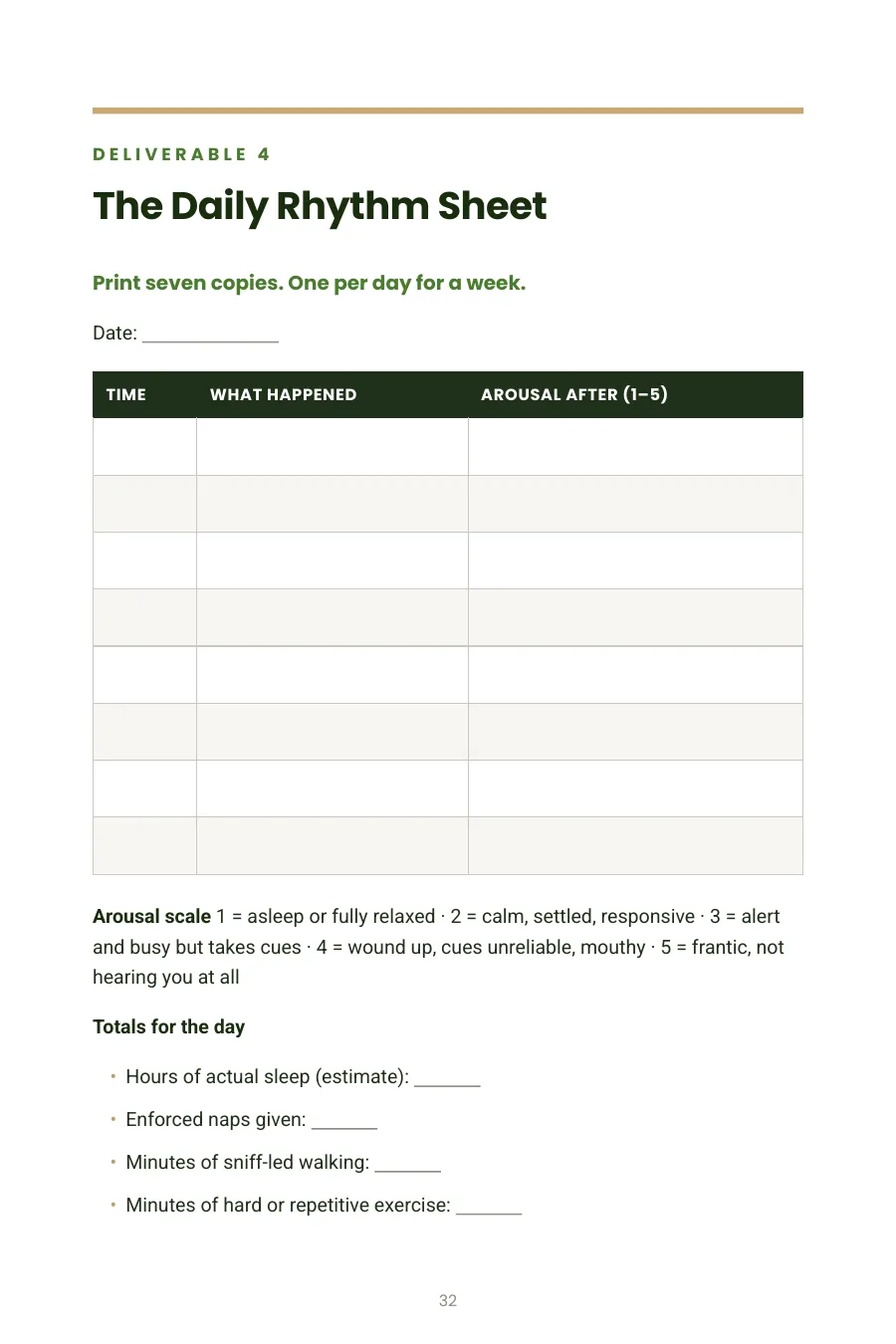
See this pageThe Daily Rhythm Sheet
Find the activities that wind your dog up and the ones that settle them.
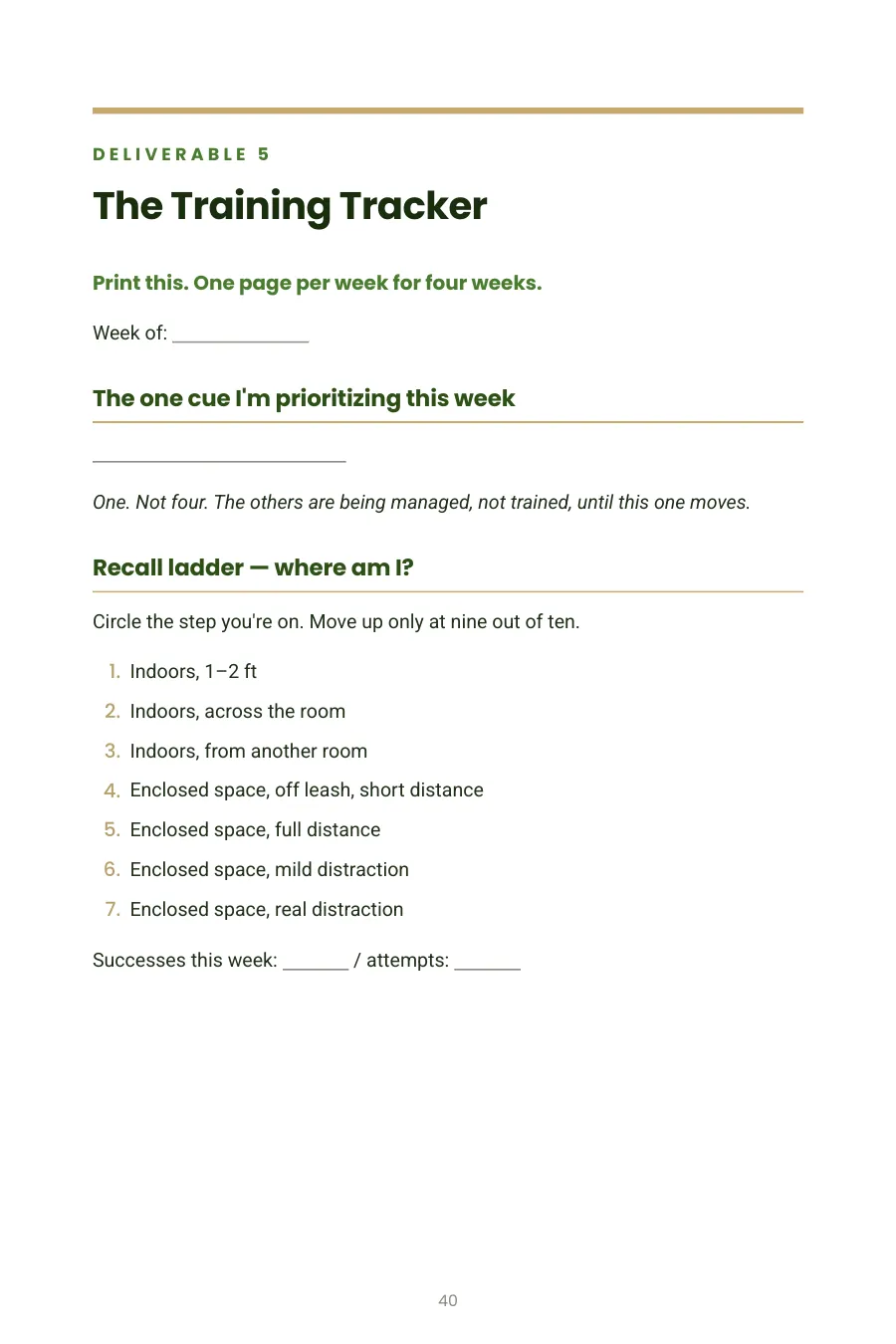
See this pageThe Training Tracker
A 7-step recall ladder and one priority cue per week.
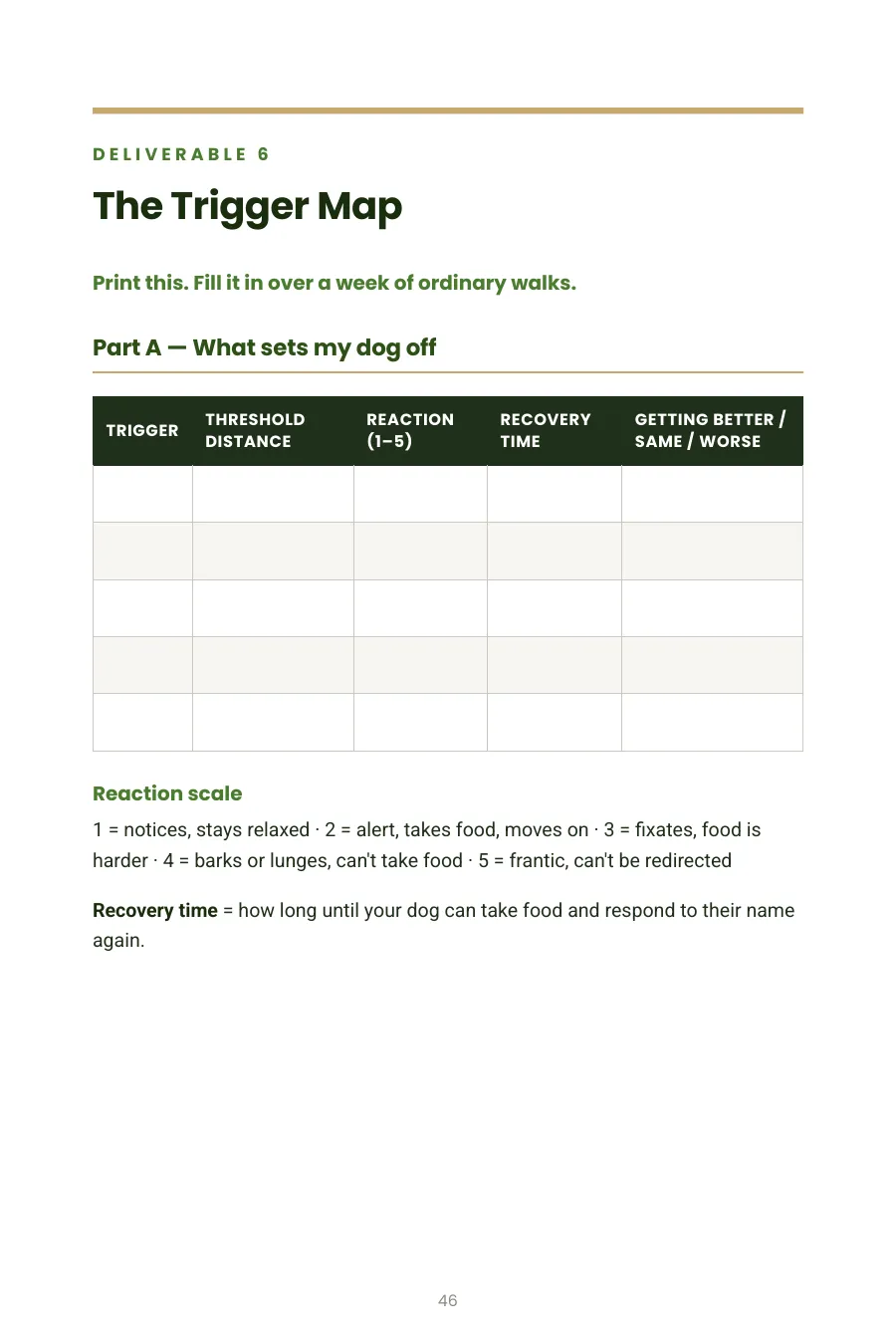
See this pageThe Trigger Map
What sets your dog off, at what distance, and a plan to close the gap.
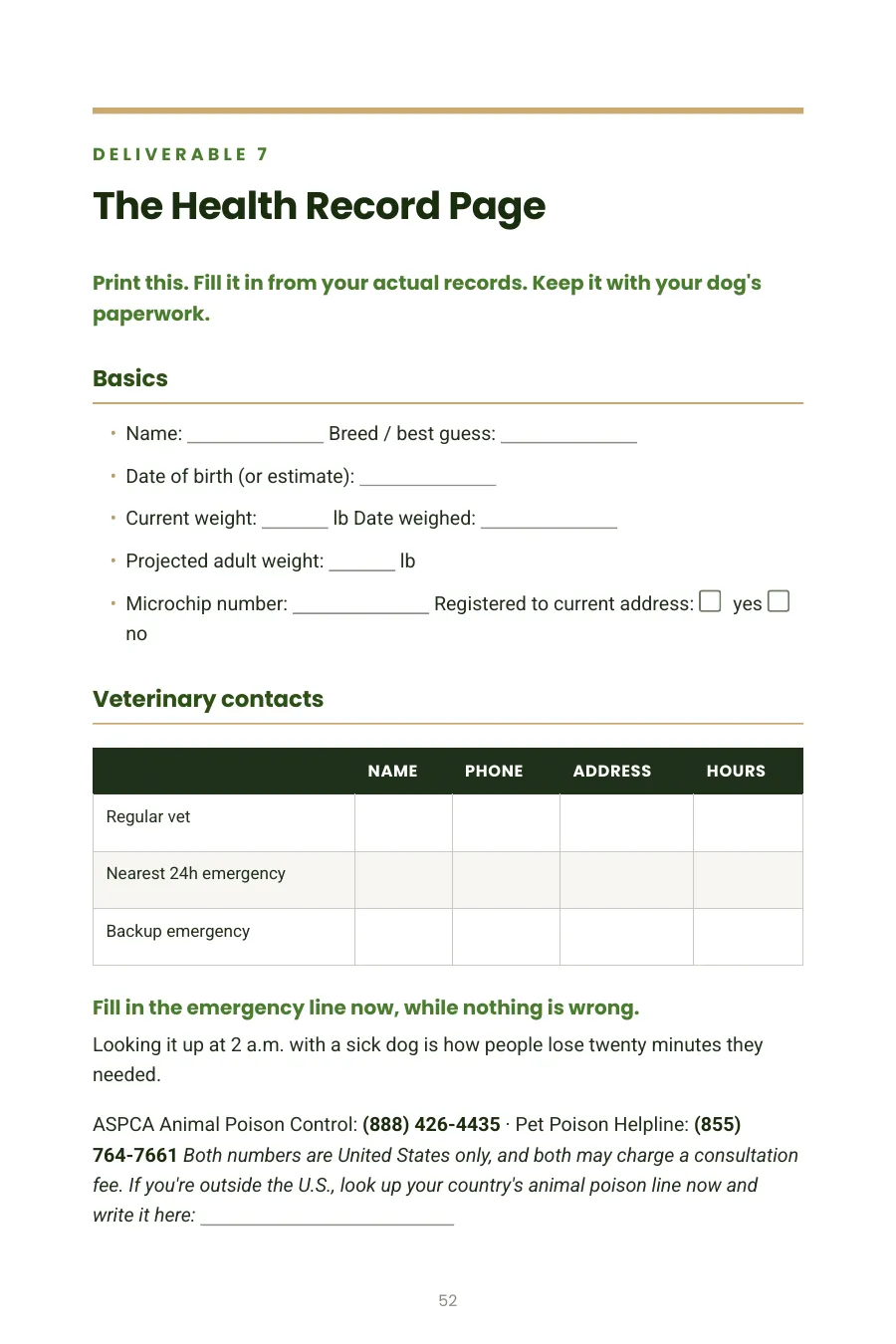
See this pageThe Health Record Page
Vaccines, growth, teeth and weight, plus a place to write down what your vet recommends.
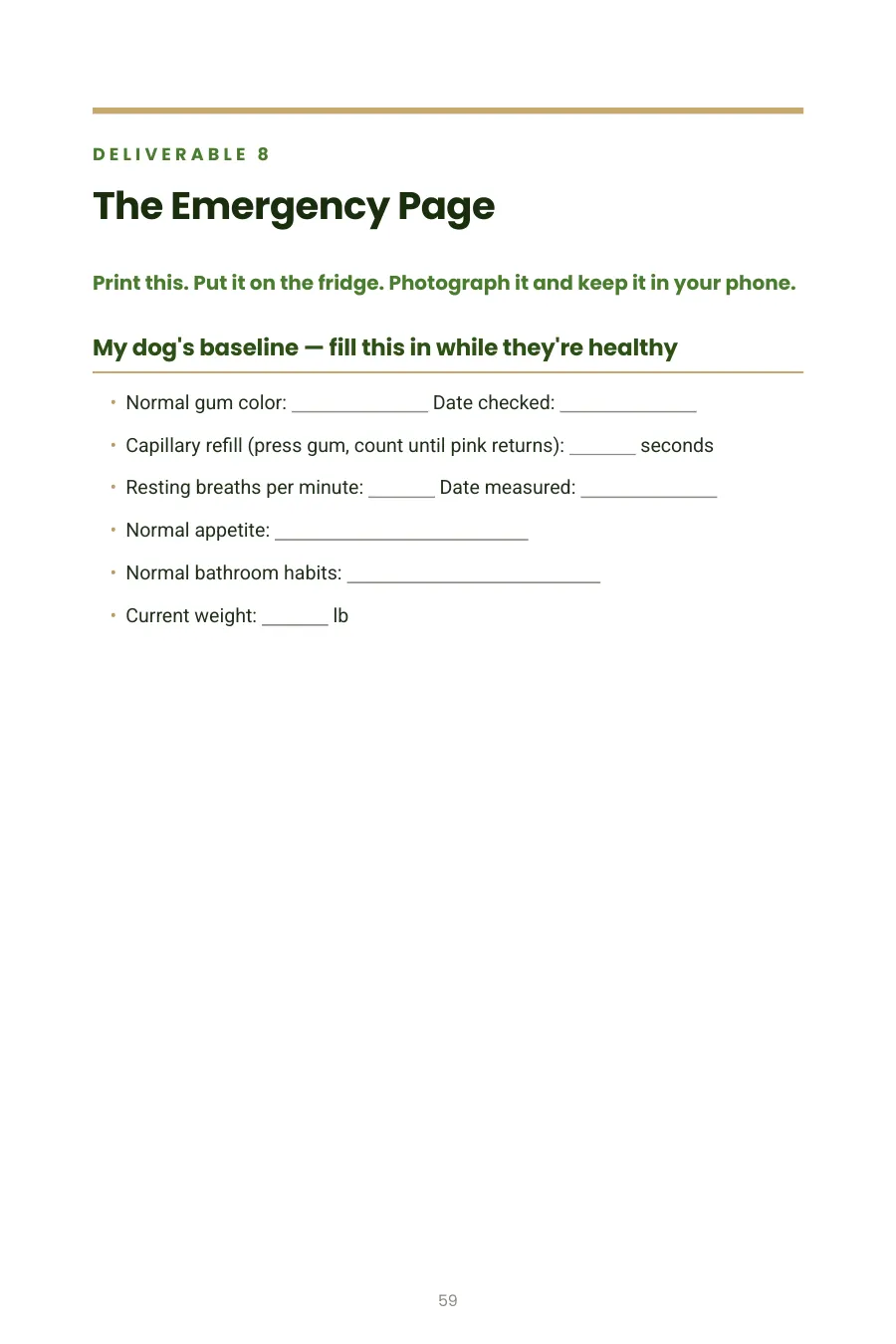
See this pageThe Emergency Page
The go-now signs, poison control numbers and your dog's baseline, for the fridge.
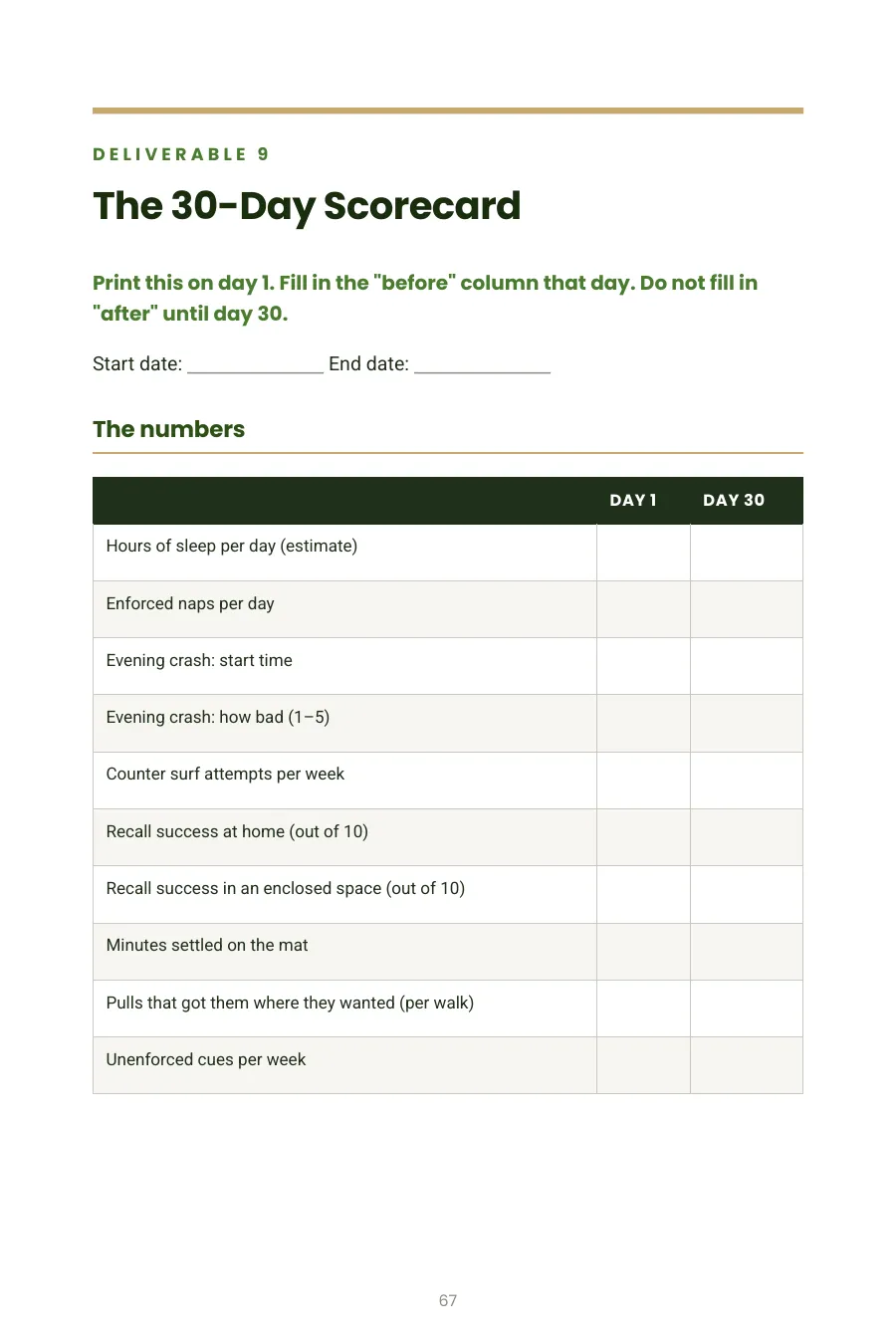
See this pageThe 30-Day Scorecard
Day 1 versus day 30, in numbers.
See this page
The research behind it
In a 2020 Newcastle University study, dogs at eight months were markedly less likely to obey their own caregiver, but not a stranger. Obedience recovered by twelve months. The researchers suggest it's a test of the relationship, not a rejection of it.
In a 2025 study of more than 1,200 young dogs, 42% of owners reported a problem behavior at twelve months. The four most common were barking, jumping up, leash pulling and recall. They're probably the same four you're dealing with.
- Asher L, England GCW, Sommerville R, Harvey ND (2020). "Teenage dogs? Evidence for adolescent-phase conflict behaviour and an association between attachment to humans and pubertal timing in the domestic dog." Biology Letters 16: 20200097. doi.org/10.1098/rsbl.2020.0097
- "Owner-Perceived Undesirable Behaviours in Young Dogs and Changes with Age." Animals (2025): 31.3% at 6 months, 35.2% at 9 months, 42.1% at 12 months. doi.org/10.3390/ani15081163
- Cornell University College of Veterinary Medicine, Riney Canine Health Center: "The teenage years," on adolescence from 6 to 18 months.
The full source list, with every health reference, is in the back of the Handbook.
How it's built, and who it isn't for
Made by dog people. My Trusted Paw started with our own dog's teenage months, and a couch that didn't survive them.
Sourced. Every health claim is checked against AAHA, AVMA, the Merck Veterinary Manual, Cornell, VCA and the AKC, plus peer-reviewed research.
No medication doses. Anywhere. Your vet sets those with your dog on the scale.
Knows when it isn't training. Chapter 8 covers 14 signs that mean go to an emergency clinic now and 8 that mean call your vet today. Your vet always has the final word.
Not for you if your dog has bitten or shows serious aggression (you need a veterinary behaviorist or a qualified force-free consultant), or if you want a finished adult dog in 30 days. Nothing honest promises that.
More questions: vet advice, spay/neuter
Is this veterinary advice? No. It's educational, it contains no doses, and it points out some of the situations where you should call your vet.
Does it tell me whether to spay or neuter? No. That decision belongs to you and your vet. The book covers the behavior claim: the surgery isn't a fix for recall, pulling, barking or fear, and the plan works the same either way.